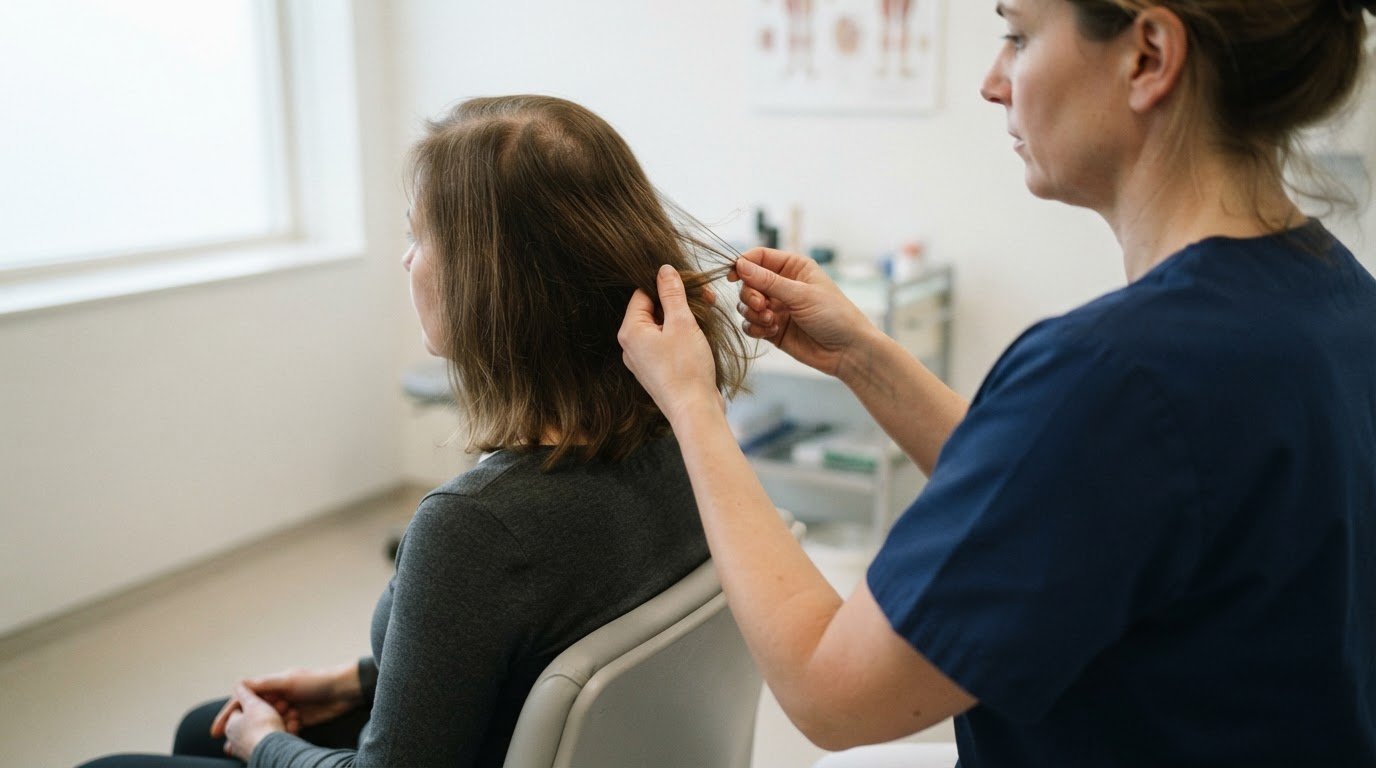

A change at the crown is a reason to look more closely, not proof that hair loss can be reversed naturally. Crown hair thinning early warning signs include finer or brittle strands, a widening whorl, and more scalp showing through than before.
It’s understandable to hope gentler care will restore density, but a natural crown whorl can reveal scalp, especially when hair is wet or the light is bright. What matters is a persistent change in coverage, strand texture, or the size of the visible area.
This guide explains how to distinguish these patterns, track them with monthly photos taken in consistent lighting and from the same angle, and recognize when scalp discomfort or progressive thinning warrants clinical assessment. That way, you can understand the signs before choosing a response, rather than reacting to one image or a single day of shedding.
Key Takeaways
- Notice whether crown hairs are becoming wiry, brittle, finer, or shorter compared with the hair around them.
- Look for a crown spot or center part that appears to widen over time, rather than judging from one view alone.
- Reduced coverage, a smoother-looking area, or more visible scalp can point to a change in density worth paying attention to.
- Persistent itching, tenderness, burning, or other scalp discomfort alongside thinning can signal a need for medical assessment.
1. What are the early signs of a balding crown?
Early crown changes can be subtle: strands may look finer or shorter, the visible scalp may extend beyond the natural whorl, or overall coverage may appear reduced. Two crown hair thinning early warning signs to watch for are a changing whorl and progressively finer strands. A receding hairline can occur with pattern hair loss, but it doesn’t establish the cause of crown thinning. The pattern, texture, and direction of change offer more useful clues than any one sign.
Progression varies by cause. Pattern hair loss may develop gradually as follicles produce finer, shorter strands, while other forms of alopecia can follow a different course. Crown thinning may become more noticeable as coverage changes over time. There’s no single timeline that applies to everyone, so track changes rather than relying on a predicted rate.
Use photographs to make those changes easier to see. Hold a smartphone about 30 cm above your crown, and take the picture under consistent lighting, with your hair arranged similarly each time. Monthly photos provide a record; compare them every 3 to 6 months, or focus on the six-month interval to assess visible change. Keep the angle and distance consistent.
Look beyond the image. Note whether the crown whorl seems wider, whether scalp shows in ordinary indoor light, and whether surrounding strands feel finer than before. Record shedding, styling changes, new products, and chemical services as context. These details may help describe what changed, but they don’t prove the cause.
Hormonal changes, stress, and other health factors can be relevant context when hair changes occur. Record when they happen alongside crown changes rather than assuming a direct cause. In women, crown thinning can also occur with iron deficiency, thyroid problems, hormonal changes, or PCOS. These crown hair thinning early warning signs can help you describe your concerns during a clinical assessment. Seek assessment for persistent scalp pain, burning, or intense itching, especially if thinning is progressing.
2. Wiry or brittle hairs as possible early signs
Wiry, brittle crown hairs can be an early sign of changing hair growth, especially when strands look shorter, finer, or less uniform than nearby hair. Pattern hair loss can gradually miniaturize follicles, producing strands with different diameters and textures. A few coarse hairs alone don’t establish a diagnosis. Notice whether the texture change persists, affects a wider area of the crown, or appears alongside breakage and reduced coverage.
Fine hairs around the crown deserve attention when they become increasingly visible among thicker strands. Compare the crown with hair at the sides, where texture may remain fuller. Check whether short strands are new growth or broken hairs: uneven ends and snapping during gentle styling may suggest breakage, while progressively finer strands can fit a pattern of miniaturization. These observations describe a pattern, not its cause.
Choose hairstyles that reduce tension while you assess the change. Loose braids, a soft bun, or wearing your hair down can help avoid repeated pulling at the crown. Tight braids, weaves, and extensions place mechanical tension on follicles; traction alopecia may develop where hair is pulled consistently. Avoid styles that cause soreness, and pause any service that burns or stings. Reducing tension can limit further mechanical stress, but it won’t diagnose or treat every type of hair loss.
Inflammation may also matter. Central centrifugal cicatricial alopecia, or CCCA, can begin at the crown, with breakage and increasing scalp visibility; some people also notice itching, tenderness, or burning. Hair-care choices shouldn’t be blamed for CCCA, and styling changes aren’t a substitute for medical assessment. If brittle crown hairs occur with persistent discomfort, smooth-looking skin, or expanding areas of loss, seek clinical evaluation. A clinician can assess symptoms and distinguish possible scarring alopecia from pattern thinning or traction-related damage.
3. Crown thinning and widening parts
A natural crown whorl can reveal some scalp, especially under bright light or when hair is wet. The key distinction is its shape: a normal whorl has a small, tight center, with hair fanning outward at full density. If exposed scalp extends beyond the center, the spot widens, or nearby strands become shorter and finer, thinning may be developing. One mirror check can’t establish the cause, so look for a consistent change in coverage.
Compare the crown in photos taken under similar lighting and from the same angle. Notice whether the visible area extends beyond the whorl or appears in ordinary indoor light, not only after washing. A center part that gradually widens can also indicate reduced density. In women, pattern hair loss often causes diffuse thinning across the top and a widening center part, while the frontal hairline is usually preserved.
Different conditions can create similar patterns. Central centrifugal cicatricial alopecia, or CCCA, usually begins as a small patch at the crown or center, then expands outward in a circular or ragged shape. Breakage and increasing scalp visibility can accompany it; the affected center may look smooth, with uneven edges. CCCA most often affects Black women. Traction alopecia more typically appears around the hairline or in areas repeatedly pulled tight.
Male pattern hair loss can also affect the crown, but crown thinning alone doesn’t identify a specific condition. Changes in follicles, strand diameter, and coverage help distinguish patterns, but they don’t confirm a diagnosis. Don’t treat a wider spot as proof that regrowth is impossible, either. Established scarring from CCCA can be difficult to reverse, making prompt assessment valuable if the area expands or becomes uncomfortable. A clinician can examine the scalp and determine whether further evaluation is needed.

4. Early crown hair thinning and reduced density
Reduced crown density can show as more scalp visible through the hair, a smoother-looking patch, or fewer visible follicle openings. Compare the crown with the sides: hair that feels softer, lighter, or finer in diameter may reflect follicle miniaturization. A thinning crown can be an early sign of male pattern baldness, even when the hairline looks unchanged. The visible pattern matters more than a single styling choice or inspection.
In the United States, treatment expenses depend on the approach, such as medication, diagnostic testing, or a procedure. The treatment plan and its duration shape the overall cost, so no single figure applies to every case.
A dermatologist assesses crown hair loss by examining the scalp, hair density, and distribution of thinning. Trichoscopy can reveal details such as peripilar white halos, an early marker associated with central centrifugal cicatricial alopecia. Depending on the findings, the dermatologist may consider dermoscopy or a biopsy to distinguish scarring alopecia from pattern loss or another condition.
Treatment risks differ by approach and individual health factors. Before starting a medical treatment, discuss its potential side effects, interactions, and suitability with the prescriber. The cause of thinning and your health history guide that conversation.
For early crown thinning, finasteride and/or minoxidil are usual medical treatment options. A stable bald area requires a different assessment, including donor capacity and the front of the scalp, before considering a transplant. No regrowth after 12 months can be a sign of persistent thinning. Tight styles do not address genetic pattern loss, while reducing tension can limit mechanical strain from braids or weaves. Match the next step to the pattern: progressive density loss, scalp symptoms, and the condition identified during assessment all matter.
ReggeneX Labs
ReggeneX Labs can help you build a consistent hair-care routine after noticing crown changes. The ReggeneX Vitalixir Hair & Scalp Consultation offers personalized guidance and routine recommendations tailored to your concerns. ReggeneX Vitalixir Hair Regrowth Serum, Shampoo, and Conditioner are additional options for a scalp-focused routine.
Turn to this support when you want guidance choosing products and organizing regular care. If thinning comes with scalp pain, burning, or persistent itching, seek medical assessment as well; product care doesn’t replace diagnosis. A clear routine can help you care for your hair consistently while monitoring changes.
Contact ReggeneX Labs to discuss your crown hair concerns and routine needs.
Make your next step a considered one
Changes at the crown can feel personal, but they can also guide a more informed conversation about your hair and scalp. Keep clear notes, and share them with a medical professional if thinning progresses or scalp discomfort appears. Early attention can help distinguish routine hair care from a concern that needs clinical assessment.
Recognizing crown hair thinning early warning signs is a starting point, not a diagnosis. The ReggeneX Labs team can help you consider your next hair-care steps through the ReggeneX Vitalixir Hair & Scalp Consultation. The range also includes ReggeneX Vitalixir Hair Regrowth Serum and ReggeneX Vitalixir Shampoo. These products support personal care, while medical assessment remains important for diagnosing scalp conditions.
For guidance that fits your concerns, contact ReggeneX Labs. Take the next step with calm, informed care.
Frequently Asked Questions
Can hair loss on the crown be reversed naturally?
Natural care alone can’t reliably reverse every cause of crown hair loss. Gentle styling and scalp care may reduce avoidable irritation or tension, but they can’t neutralize genetic sensitivity to DHT or reverse severe follicle miniaturization. Scarring conditions need particular attention because established follicle damage can be difficult to reverse. The right next step depends on what is causing the change.
What Does Hair Thinning at the Crown Look Like?
Crown thinning can look like a larger area of visible scalp, less coverage under overhead lighting, or hair that no longer conceals the scalp as it once did. A natural whorl can show some scalp, so compare how the area looks with dry, clean hair arranged normally. A persistent change in coverage is more informative than one image taken after styling.
What are the early signs of a balding crown?
Early clues can include shorter, finer strands, increased breakage, or a crown area that gradually looks less full. You may also notice that a familiar hairstyle no longer falls or parts the same way. These observations can guide a discussion about hair changes, but they don’t identify the cause on their own. Note whether the change is isolated or accompanied by scalp symptoms.
What Are the Early Signs of Hair Loss?
Hair loss may first appear as more shedding than usual, weaker-looking strands, or a hairstyle that seems less dense. Location offers another clue: traction-related loss often affects areas under repeated pulling, while pattern loss can involve the crown or top. Changes can also follow illness, hormonal shifts, or other health factors, so the timing and distribution help frame an assessment.
Why Does Hair Thin Specifically on the Crown?
The crown’s whorl makes changes in density more visible because strands radiate from a central point. In pattern hair loss, inherited sensitivity to DHT can gradually shrink follicles and produce finer hairs. Other conditions can also affect the crown, including CCCA, which may involve inflammation and scarring. Location alone doesn’t reveal which process is responsible.
Why is early care important?
Early attention can help clarify whether thinning relates to pattern hair loss, traction, or a scalp condition that needs medical assessment. That distinction matters because these causes call for different responses. For example, ongoing tension from a tight style can be reduced, while pain or persistent burning alongside crown changes warrants prompt clinical evaluation. Avoid starting treatments before considering the likely cause.