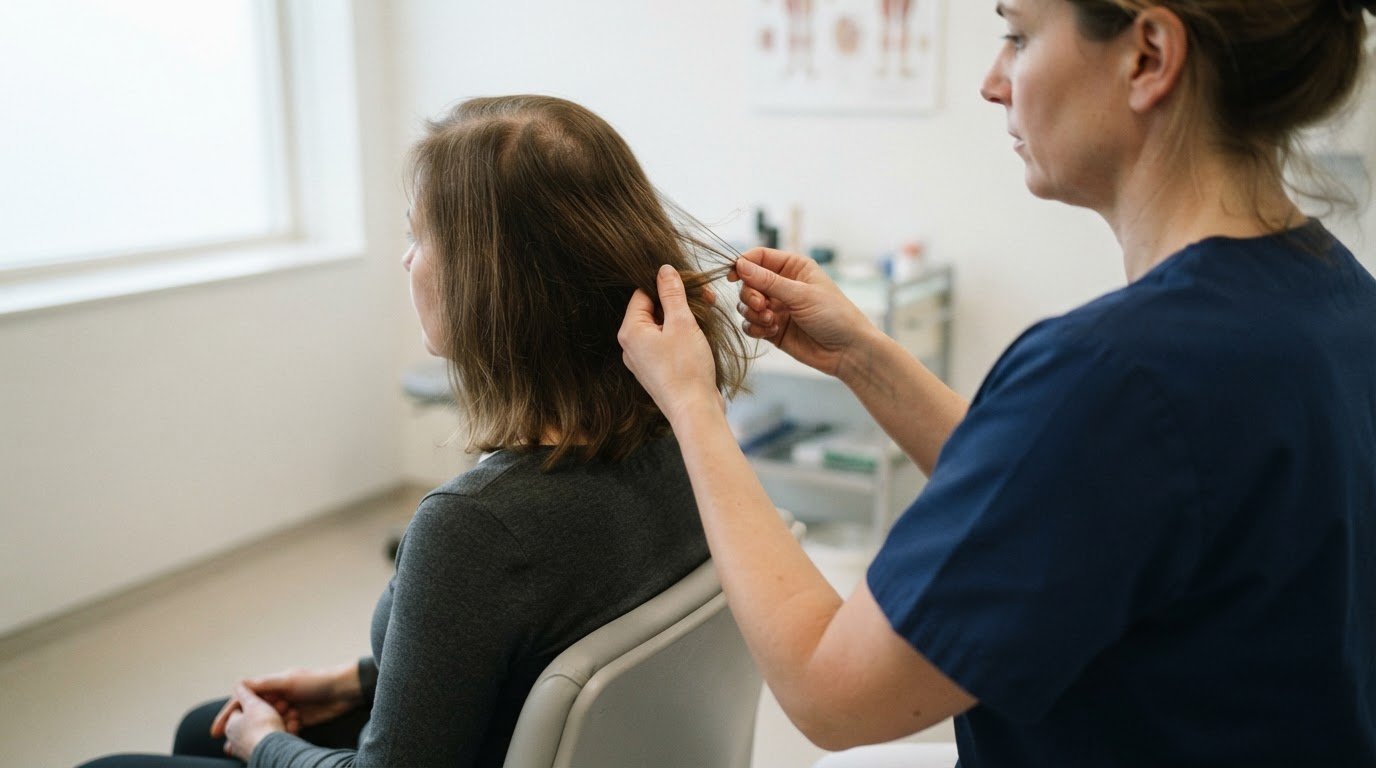

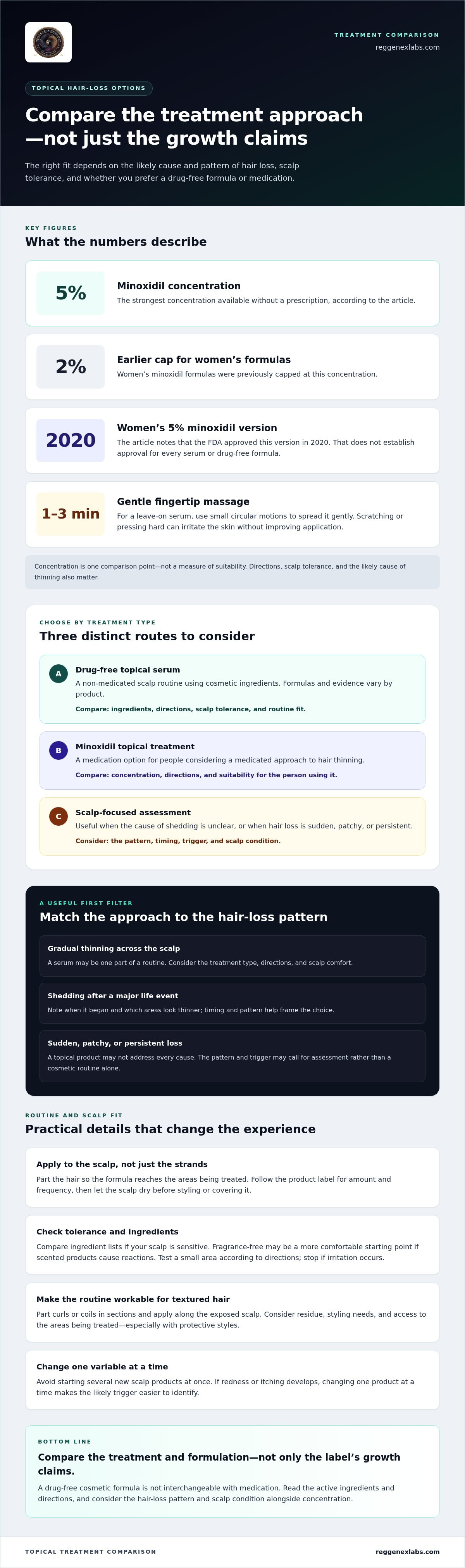
The strongest option isn’t automatically the right hair regrowth serum. The best fit depends on what’s driving the hair loss and whether you prefer a drug-free formula or a medication; 5% minoxidil is the strongest concentration available without a prescription.
It’s understandable to want one clear answer, especially when products promise different ingredients and approaches. A more useful comparison is to match the treatment type to your needs, understand what its ingredients can and can’t tell you, and consider how it has been tested across hair types and textures.
This guide explains how drug-free serums compare with prescription treatments, what to look for in a formula, and how testing evidence should shape your expectations. You’ll also learn why the cause and pattern of hair loss matter when choosing a topical approach, so you can weigh your options more clearly.
Key Takeaways
- Choose a topical treatment based on the pattern and likely cause of hair loss, not ingredient claims alone.
- Apply scalp products as directed and use a gentle massage to spread them evenly without irritating the scalp.
- Compare drug-free formulas with minoxidil by treatment approach, concentration, and fit for your needs.
- After postpartum shedding, consistency matters: visible changes can take several months of regular use.
- Look beyond hair-type labels when assessing product testing; texture, application, and real-world use all shape the experience.
What serum is best for hair growth?
The best hair regrowth serum depends on the cause of hair loss, your scalp’s tolerance, and whether you prefer a drug-free formula or medication. Topical products may support some forms of thinning, but they don’t address every cause. Sudden, patchy, or persistent shedding calls for an assessment of its pattern and trigger.
Start with the application directions on the product label. Part the hair so the formula reaches the scalp rather than coating the strands, then apply it to the areas you want to treat. For a leave-on serum, massage gently with your fingertips for 1-3 minutes, using small circular motions. Avoid scratching or pressing hard, since friction can irritate the skin without improving application.
Keep your routine consistent and practical. Apply the amount and frequency stated on the label, and let your scalp dry before styling or covering it. Don’t combine several new scalp products at once. If redness or itching develops, changing one product at a time makes the likely trigger easier to identify. A serum can’t replace diagnosis when hair loss begins suddenly or appears in distinct patches.
If you have a sensitive scalp, compare ingredient lists before choosing. A fragrance-free formula may be a more comfortable starting point if scented products cause reactions. Test a small area according to the product directions before applying it across your scalp, and stop using it if irritation occurs. If your scalp is already inflamed, tender, or broken, avoid adding a new topical product until the cause is assessed.
| Option | Best suited to | What to compare |
|---|---|---|
| Drug-free topical serum | Those who prefer a non-medicated topical routine | Ingredients, directions, and scalp tolerance |
| Minoxidil topical treatment | Those considering a medication for hair thinning | Concentration, directions, and suitability for the person using it |
| Scalp-focused consultation | Those unsure what may be driving their shedding | Hair-loss pattern, timing, and scalp condition |
Choose by matching the treatment type to the likely cause, then weigh application requirements and scalp comfort.
Different causes call for different decisions. Gradual thinning across the scalp, shedding after a major life event, and hair loss concentrated in one area are distinct patterns. A serum may be one part of a routine for gradual thinning, while sudden or patchy loss calls for attention to the underlying cause. Note when shedding began, where it appears, and whether your scalp feels irritated. These details help narrow product choices and distinguish a cosmetic routine from a need for clinical assessment.
Drug-free versus prescription topical treatments
Topical options differ in active ingredients, evidence, access, and fit with your routine. Compare the specific treatment and formulation, not just the label’s growth claims.
Drug-Free Topical Treatments
Drug-free formulas use cosmetic ingredients rather than medication such as minoxidil. They may suit someone seeking a non-medicated scalp routine, but ingredients and evidence vary by product. Read the full ingredient list, directions, and claims before choosing. A botanical or cosmetic formula isn’t interchangeable with medication simply because both target thinning.
When shopping on a budget, compare how often a product must be applied and how much routine it requires. A lower purchase price doesn’t tell you how long a bottle lasts or whether its directions fit your habits. Avoid buying several formulas at once. Choose one, follow its directions, and assess whether it suits your scalp and schedule before adding another topical step.
Textured hair calls for practical access to the scalp. Part curls or coils in sections, apply the formula along the exposed scalp, and avoid spreading most of it over the hair lengths. Consider whether the texture leaves residue or disrupts your styling routine. Protective styles can make direct application harder, so plan access to the areas you’re treating without pulling or repeatedly disturbing your hair.
Approval and Legitimacy Checks
To assess an FDA-approval claim, identify the exact active ingredient, strength, and formulation named on the product. The FDA approved the women’s 5% minoxidil version in 2020; that fact doesn’t establish approval for every serum or every drug-free formula. Check that the product’s wording refers to the specific treatment, rather than implying that a general hair-growth claim proves approval.
Marketing language alone can’t tell you whether a topical treatment is medication or a cosmetic formula. Check the package for active ingredients and directions, then compare those details with the claims. If a product calls itself drug-free, don’t assume it contains minoxidil. If it claims FDA approval, look for a precise reference to the treatment rather than broad phrases such as “clinically inspired.”
Minoxidil offers a distinct route from drug-free options. The strongest concentration available without a prescription is 5%, and women’s minoxidil formulas were previously capped at 2%. Those details help frame a comparison, but concentration alone doesn’t settle suitability. Consider the product’s directions, your scalp’s tolerance, and whether a medicated approach matches your needs.
For a drug-free approach, compare topical hair-care options by ingredients and routine fit.
Hair serums for postpartum hair loss
Postpartum shedding can change how your hair looks and feels during an already demanding period. A topical routine may be one option, but timing, ingredients, and the pattern of shedding matter. Track when shedding began, which areas look thinner, and whether your scalp has changed. These details can help distinguish a temporary change from a pattern that needs further assessment.
If you’re pregnant or breastfeeding, speak with a healthcare professional before starting a medicated topical treatment. Read the product label and review its active ingredients, since drug-free formulas and minoxidil-based treatments aren’t interchangeable.
Consistency is central to evaluating a treatment. Hair-loss treatments are advised for daily use over 3-6 months, while visual changes may take time to emerge. At three months, some patients may begin to see reduced shedding and slightly improved scalp coverage. Visual improvements typically take 3-6 months of consistent use. These timelines help set expectations, but they don’t mean every person will see the same change.
Build a routine you can maintain around feeding, rest, and daily care. Choose one topical product, follow its label, and record use in a calendar or phone reminder. Take a scalp photo under similar lighting at regular intervals, using the same part and camera angle. Compare images over time rather than judging progress after a single wash or styling session.
Hair changes can affect confidence, social comfort, and your sense of control over your appearance. A widening part, extra strands in a brush, or less fullness in a ponytail can make shedding feel constant. Name the specific change that concerns you, then discuss it with someone you trust or a healthcare professional. If repeatedly checking the mirror increases distress, use scheduled photos instead of daily comparisons.
Pair any serum routine with gentle handling. Detangle from the ends upward, reduce tension from tight styles, and avoid adding several new scalp products at once. Changing your shampoo, styling products, and treatment in one week, for example, makes reactions harder to trace. Introduce one change at a time and note any itching, redness, or discomfort alongside shedding.
- Record the start of shedding and the areas affected.
- Use a daily reminder to follow the product label consistently.
- Compare photos taken under similar conditions across 3-6 months.
- Discuss a medicated treatment with a healthcare professional during pregnancy or breastfeeding.
Postpartum hair changes deserve attention without becoming the sole measure of recovery. A clear timeline, a manageable routine, and support for emotional strain can help you make grounded decisions as you observe changes over several months.
Hair-growth ingredients and formulations
Ingredient names can make formulas sound comparable, but the evidence for each differs. Read the claim, ingredient, and study context together before choosing.
Hair-Growth Ingredients
Redensyl, pumpkin seed extract, saw palmetto, and caffeine appear in discussions of topical hair growth. Reported findings use different measures, so their percentages aren’t directly comparable. Laboratory follicle thickness, hair count, and growth-phase duration, for example, describe distinct outcomes.
Laboratory in vitro studies reported a 200% increase in thickness for Redensyl-treated follicles compared with untreated follicles. A 2014 study reported a 40% increase in hair count after 24 weeks of pumpkin seed extract use, and a 30% improvement in hair thickness after 24 weeks. These findings describe particular study conditions, not a guaranteed result from every finished formula.
Clinical reviews reported that saw palmetto reduced scalp androgen receptor activity by 50%. Topical caffeine was reported to extend the anagen, or growth, phase by 37%, and increase hair shaft elongation by 46%. Those figures refer to different effects. Compare the ingredient’s stated role and evidence type, rather than ranking formulas by the largest percentage alone.
Serum Formulations
A serum’s formulation affects how it fits into your routine, how it spreads, and what remains on your hair. Liquid products can be applied along part lines, while thicker formulas may require careful sectioning. Consider the ingredient list alongside texture: a botanical extract in a serum isn’t automatically equivalent to a studied extract used under specific conditions.
Check the full label for active and supporting ingredients, directions, and warnings. If a formula highlights several compounds, identify which claims refer to each one. A product may combine caffeine with plant extracts, for example, but findings on individual ingredients don’t establish how that finished combination performs.
Match the formula to your scalp and styling routine. Part your hair in sections, apply the product to the scalp as directed, and observe whether it leaves residue or disrupts styling. Keep the rest of your routine stable while assessing a new formula, so changes are easier to interpret. If a label refers to a study, note whether it measured follicles in a laboratory, people using an ingredient, or the finished product itself.
Use evidence with precision. A laboratory result for Redensyl, a 2014 pumpkin seed extract study, and reviews of saw palmetto don’t establish identical outcomes. Compare study setting, measured effect, and the actual ingredients in the product before deciding what a formulation can reasonably offer.
Product testing across hair types and textures
A formula’s daily usability can vary with hair texture, styling habits, and scalp access. Testing should consider more than the ingredient list: assess how easily the product reaches the scalp, whether it leaves residue, and how well application fits different routines.
Products in the testing process were tried for 2-4 weeks before advancing to the next consideration round. Testing continued for one calendar year. That staged approach can reveal practical differences, such as whether a watery formula runs through tightly curled hair or a thicker serum is easier to apply along parts.
Texture changes the application experience. Straight or loose-wave hair may allow quick access to the scalp, while curls and coils often need section-by-section application. A tester should note whether the product spreads without saturating the hair, disrupts a style, or leaves visible residue. These observations describe usability, not proof that a formula causes regrowth.
Good testing also considers how products fit different routines. Someone who washes less often, for example, may prioritize a leave-on formula that doesn’t feel heavy between wash days. Someone wearing braids may need clear scalp access and an applicator that reaches exposed parts. Record the application method, feel, and styling impact consistently across testers.
Comparing prices takes more than looking at a bottle’s sticker price. Check the amount supplied, directions, application frequency, and whether a purchase renews automatically. Subscription cycles affect when products arrive and charges recur, so review renewal terms and cancellation details before enrolling. Compare cost per use only when package size and directions provide enough information to calculate it.
Benefits and trade-offs are personal. A lightweight serum may spread easily but feel less comfortable if you prefer richer products. A concentrated routine may be simple to follow but still require regular application. For textured hair, easy scalp access can be an advantage, while residue or styling disruption can be a drawback. These are practical fit criteria, not guarantees of efficacy.
- Pros: A staged trial can identify texture, residue, and application concerns before wider consideration.
- Cons: Short testing periods can assess usability, but don’t establish long-term results across every hair type.
- Compare: Assess scalp access, application feel, routine compatibility, and renewal terms.
Use those criteria to compare products for your own texture and routine, rather than relying on a broad “all hair types” claim. For a routine built around scalp care, explore hair-care options.
ReggeneX Labs: ReggeneX Vitalixir Hair Regrowth Serum
ReggeneX Vitalixir Hair Regrowth Serum is a topical option to consider when comparing hair-care routines. Weigh it against the factors covered in this guide: ingredient transparency, scalp comfort, application habits, and fit with your hair texture. A product name alone can’t establish whether a formula suits your needs.
If you want help planning your scalp-care routine, ReggeneX Vitalixir Hair & Scalp Consultation offers a focused next step. ReggeneX Vitalixir Shampoo and ReggeneX Vitalixir Conditioner can also be part of everyday hair care. Keep your choices aligned with your hair-loss pattern and preferred treatment approach.
Visit ReggeneX Labs to explore the serum and related hair-care options, or contact ReggeneX Labs with your questions.
Choose a Routine You Can Sustain
Turn your comparison into a considered routine. Before choosing a hair regrowth serum, decide what matters most to you: a drug-free approach, a medicated treatment, scalp comfort, or ease of use with your usual styling. Keep that priority in mind as you compare products, and avoid changing several parts of your routine at once.
If you’re unsure which approach fits your hair-loss pattern, ReggeneX Vitalixir Hair & Scalp Consultation can help you explore your options. ReggeneX Labs also offers ReggeneX Vitalixir Hair Regrowth Serum and ReggeneX Vitalixir Shampoo as part of its hair-care range. Choose the next step that best matches your needs, then build a routine you can follow consistently.
Contact ReggeneX Labs to discuss your hair-care needs. A thoughtful choice is a practical place to begin.
Frequently Asked Questions
Which ingredients in a hair regrowth serum have evidence behind them?
Evidence depends on the ingredient and study type. Minoxidil is a medication, while Redensyl, pumpkin seed extract, saw palmetto, and caffeine appear in other topical formulas. Research on these ingredients measures different outcomes, so a study of one ingredient doesn’t prove that every finished formula works the same way. Compare the ingredient, the outcome measured, and whether the evidence concerns the ingredient or the product.
How long does a topical treatment take to show results?
Allow several months of consistent use before judging visible change. Hair-loss treatments are commonly used consistently for 3-6 months, and visual improvements typically take 3-6 months. To make comparisons useful, choose a baseline photo, then repeat it with the same part, lighting, and camera angle. Changes in styling or lighting can make density look different even when the underlying pattern hasn’t changed.
How much does a serum cost in the United States?
There isn’t one standard US cost for every formula or routine. What you spend depends on the product, the amount it contains, its directions, and how often you use it. For a fair comparison, check the supply duration and whether a subscription renews automatically. Compare cost per use only when package quantity and application directions provide enough information to calculate it.
How do prescription hair loss treatments compare with over-the-counter options?
Prescription treatments are medications, while over-the-counter options may include medication or drug-free cosmetic formulas. The category alone doesn’t tell you what a product contains: check its active ingredient and directions. For example, 5% minoxidil is the strongest concentration available without a prescription. Compare the treatment type, intended use, and label instructions, rather than assuming every topical product follows the same approval or evidence standards.
How should you apply a hair regrowth serum, and how often?
Follow the product label for both amount and frequency. Part the hair to expose the scalp, apply the formula where directed, then massage gently with your fingertips for 1-3 minutes. Avoid applying extra product to compensate for missed use. For textured hair, work through sections so the serum reaches the scalp rather than coating the strands. Keep the routine consistent with the product’s directions.
What are the side effects and risks of topical hair treatments?
Risks vary with the active ingredient and the rest of the formula. Read the label for warnings and directions, and introduce one new topical product at a time so you can identify what may be causing a reaction. If you notice scalp discomfort or irritation, stop using the product and seek advice from a healthcare professional. Don’t assume a drug-free formula carries the same cautions as medication.
Does minoxidil serum regrow hair, and how effective is it?
Minoxidil is a medication used as a topical treatment for hair thinning, but the material gives no specific effectiveness rate. With consistent use, visual changes may take 3-6 months, and results vary by person.