
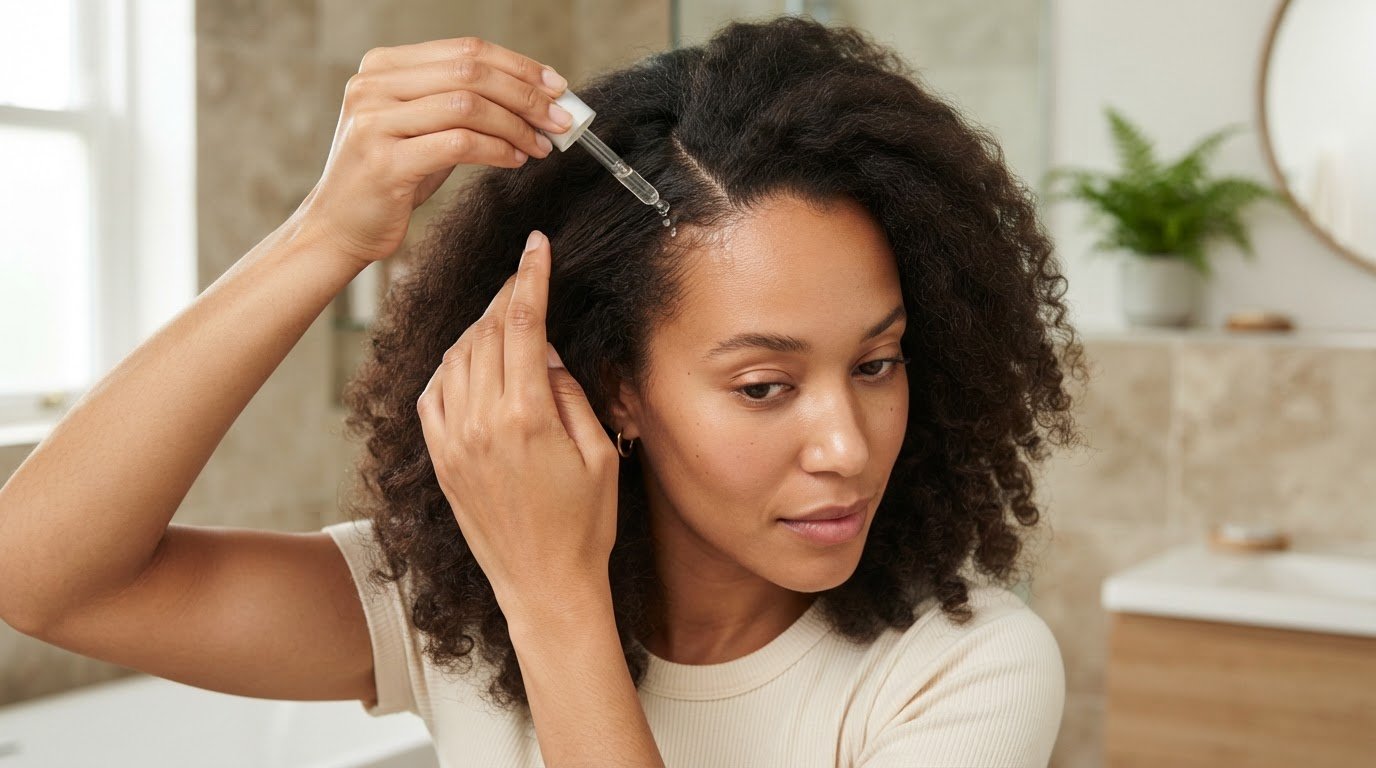
How to use hair growth serum depends on the formula, so follow its label. Scalp serums may be used anywhere from three times a week to daily. Part your hair to expose the scalp, apply the serum directly to the skin, then gently massage it in with your fingertips. Consistency matters, but using more product or applying it more often isn’t automatically better.
It’s easy to assume serum works like a styling product, applied to the hair whenever it needs a boost. Scalp serum is different: careful placement and a routine suited to the formula help you use it as directed. Check the label for the amount and frequency.
This guide explains how to section your scalp, apply and massage in serum, and set a routine based on the product instructions. You’ll also learn how to avoid common application mistakes and keep your routine simple and manageable.
Key Takeaways
- Follow the serum’s product label for frequency; scalp formulas may be used from three times a week to daily, depending on the product.
- Part your hair into sections so you can place the serum on the scalp rather than spreading it mainly through the hair.
- Massage gently with your fingertips to distribute the formula without vigorous rubbing.
- Keep the routine consistent and allow at least 12 weeks before judging progress.
- Avoid adding more product or using it more often than directed; the right routine depends on the formula and its instructions.
How Often Should You Use a Hair Growth Serum?
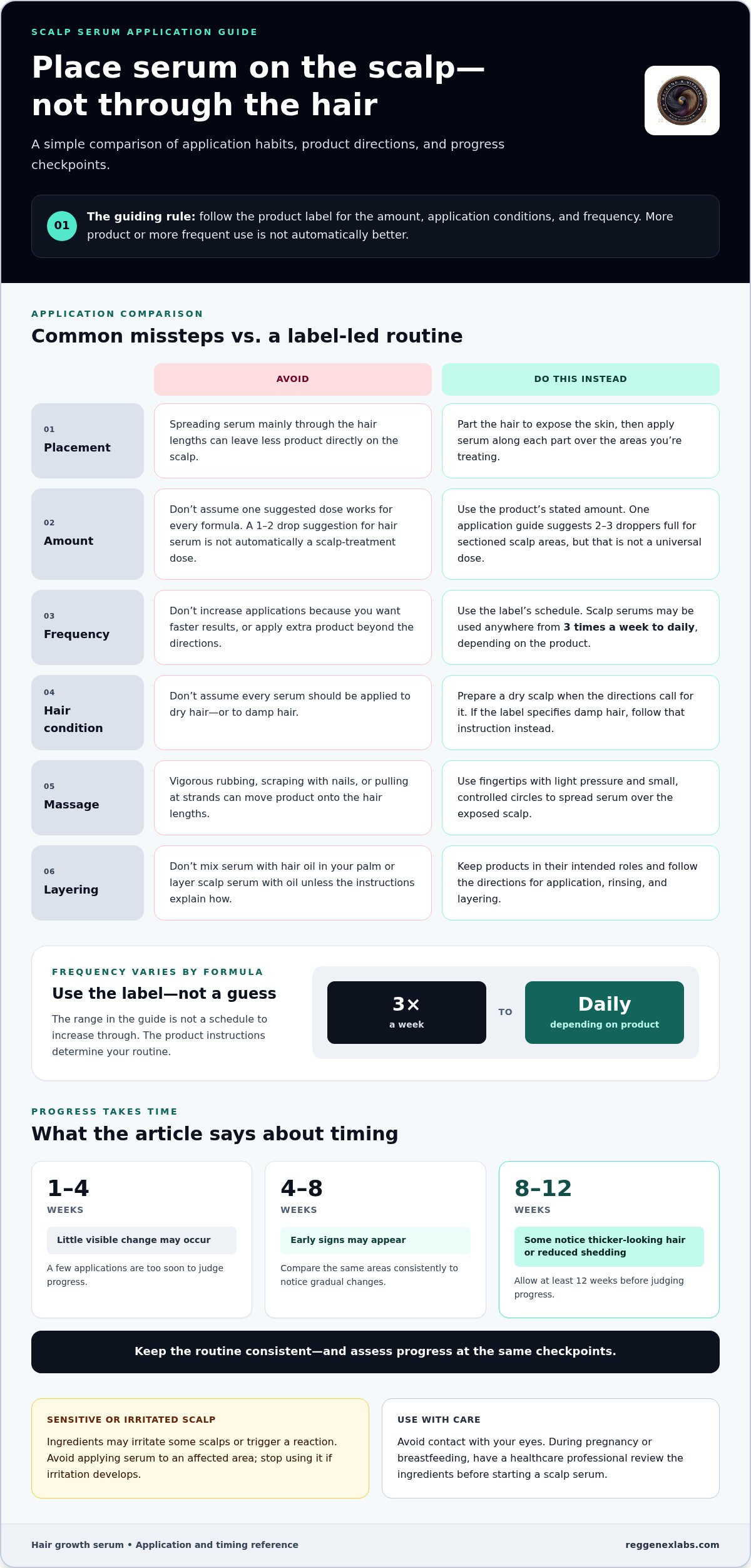
For a scalp serum, the amount depends on its instructions and the areas you’re treating. One application guide recommends 2-3 droppers full, placed directly onto sectioned scalp areas. Don’t use that amount as a universal dose: follow your product label.
Possible risks depend on the formula and your sensitivity. Ingredients may irritate some scalps or trigger a reaction. Stop using the product if irritation develops, and avoid contact with your eyes.
If you know you’re sensitive to an ingredient or have an irritated scalp, avoid applying serum to the affected area. During pregnancy or breastfeeding, don’t start a scalp serum until a healthcare professional has reviewed its ingredients.
- Read the label before opening the serum. Check its application directions, recommended amount, and frequency. Scalp serums may be used from three times a week to daily, depending on the product. Use the label’s schedule rather than increasing applications because you want faster results.
- Prepare a dry scalp when the product directions call for it. Separate dry hair with your fingers or a comb, then expose one narrow strip of skin. Applying directly to the scalp keeps the formula near the roots instead of coating the lengths. If the label specifies damp hair, follow that instruction instead.
- Work in sections across the areas you’re treating. Part the hair, place the serum along the exposed scalp, then make another part beside it. Repeat over the target area so the liquid reaches skin beneath the hair. For fine hair, use the nozzle carefully to avoid saturating the strands; don’t assume fine hair means a smaller scalp dose than the label directs.
- Distribute the application without flooding one spot. Use the applicator to place serum along each part, following its stated dose. If the directions call for drops rather than droppers, measure them as instructed. A 1-2 drop suggestion for fine or short hair applies to hair serum amounts, not automatically to a scalp-treatment dose.
- Finish with a light fingertip massage. Gently press and move your fingertips over the treated parts to spread the serum across the scalp. Avoid vigorous rubbing, which can shift product onto the lengths. Let the application settle as directed, then wash your hands and keep the next application consistent with the label.
Massaging serum into the scalp
Hair growth serum can fit alongside shampoo, conditioner, and styling products. Use each as its label directs, and don’t layer scalp serum with hair oil unless the instructions explain how to do so.
- Know what you’re applying. Scalp serum is formulated for application to the skin beneath the hair. Hair oil is generally oil-based and may coat the scalp or strands; a serum often has a lighter texture. Check the product directions to see whether it’s a leave-in treatment or needs rinsing.
- Place the formula on exposed scalp. Use your fingertips or the applicator to make a part, then apply serum along the skin. Work across each area you’re treating. Avoid dragging the formula down the lengths, where it may leave fine hair looking weighed down instead of reaching the scalp.
- Massage gently with your fingertips. Set your finger pads against the scalp and make small, controlled circles. Move from the front hairline toward the crown, then cover the sides and back as needed. Keep pressure light; don’t scrape with your nails or pull against the strands. The goal is even distribution, not forceful rubbing.
- Use a consistent, comfortable motion. Massage each treated part briefly, then move to the next. If the serum begins to spread onto the hair lengths, reduce pressure and return to the exposed scalp. A scalp massager can be used only if its directions suit the serum and your scalp; keep contact gentle and clean the tool as directed.
- Layer products deliberately. For a caffeine and Redensyl scalp treatment, follow its label for application and layering. Don’t mix it with hair oil in your palm, since combining formulas can change how they spread. If you also use shampoo, conditioner, or styling products, keep them in their intended roles and avoid coating the treated scalp with unrelated products immediately.
- Match the serum to the concern. Some people add scalp serum to a routine focused on dryness, excess oil, or hair loss, but the formula determines its purpose. Serum can deliver its ingredients to the scalp, while hair oil mainly coats skin or strands. If your scalp is extremely oily or you have a medical condition, consult a dermatologist before adding a scalp serum.
- Watch how your scalp responds. Stop using the treatment if you notice irritation, persistent discomfort, or a new reaction. Avoid applying it to broken or inflamed skin. A simple routine makes it easier to identify whether the serum, oil, or another product is causing the problem.
Mistakes that can delay results
Some people notice thicker-looking hair or reduced shedding around 8 to 12 weeks after starting a serum. Little visible change may occur during weeks 1 to 4; early signs may appear during weeks 4 to 8. Allow at least 12 weeks before judging progress.
- Don’t judge progress after a few applications. Hair changes take time to assess, so compare the same areas consistently. Note visible changes at the start, then review them at 4, 8, and 12 weeks. These checkpoints help distinguish a gradual change from day-to-day differences in styling, lighting, or how your hair sits.
- Follow the product label instead of increasing the dose. Applying extra serum or using it more often than directed doesn’t establish a faster routine. The ingredients and directions determine how the formula should be used. Measure each application as instructed, and avoid doubling the next dose after missing one.
- Keep applications consistent. Skipping days and restarting unpredictably makes it harder to assess a routine over 12 weeks. Choose a practical time that fits the label, such as after your usual wash, if its instructions allow. Track applications in a calendar rather than relying on memory.
- Place serum where it’s intended to go. Hair serum applied mainly to the lengths may smooth strands, but scalp serum belongs on the scalp. Part the hair and apply along the exposed skin. Don’t pour a large amount over the hair and expect it to reach every treated area evenly.
- Avoid changing several products at once. Adding multiple treatments together makes it difficult to identify which ingredients suit your scalp. Introduce products according to their separate labels, and keep a simple record of what you use. If you notice irritation after a new formula, stop that product rather than adding another treatment to counter it.
- Watch for buildup from layered products. Regularly using multiple silicone or oil products can leave residue on the scalp and hair. If these products are part of your routine, clarifying shampoo may be used once every 2-4 weeks. Don’t overuse clarifying products; follow their directions and adjust based on your hair’s response.
- Don’t confuse a temporary appearance change with progress. Styling, lighting, and freshly washed hair can make strands look thicker on one day. Compare similar conditions at the 12-week mark, such as the same part and lighting. A steady record is more useful than judging results after each wash or styling session.
The four-section application method
- Prepare the scalp and identify the treatment area. Start with clean, dry hair unless the serum label directs otherwise. Use a comb to make a center part from the front hairline to the nape. Then create a cross-part from ear to ear. These two lines divide the scalp into four sections: front left, front right, back left, and back right. Keep the serum’s stated dose in mind before applying it.
- Apply serum to the first front section. Clip away the other three sections so hair stays clear of the exposed scalp. Make a narrow part within the front-left area, then apply the serum along the skin, not across the hair shafts. Move the part slightly and repeat until you’ve covered that section. Use the applicator to control placement and preserve the product amount indicated on its label.
- Repeat the same pattern in the other three sections. Work across the front-right area, then move to the back-left and back-right. For each section, expose a strip of scalp, apply along the part, and reposition the hair before the next application. This sequence helps distribute serum across the intended area without concentrating it at the hairline or crown. Keep the sections distinct until each has been treated.
- Check coverage before finishing. Look at the four areas in a mirror, or use a hand mirror to inspect the back. If a visible patch of the targeted scalp was missed, part the hair there and apply only as the label permits. Don’t add extra serum simply to make the scalp feel wet. Even placement supports consistent contact; more product doesn’t automatically mean better absorption.
- Let the application settle as directed. Release the clips once the serum is placed across all four sections. Avoid brushing the product down the lengths or immediately layering oil over the treated scalp. Follow the label’s directions for drying, styling, and any next product. A repeatable four-section sequence helps you apply the formula methodically, monitor coverage, and maintain a healthier scalp-care routine.
Use the part lines as a guide, not rigid boundaries. The goal is to expose the scalp in manageable strips and work through the target area without losing track of what you’ve covered. Divide your hair into several sections to help distribute the serum evenly. Clip untreated hair aside so you can see each part and avoid repeatedly applying serum to the same strip.
Move from one exposed strip to the next, repositioning your hair so the applicator reaches the skin. If a part closes before you apply the serum, open it again rather than spreading product over the hair. After treating an area, pause to check that you’ve covered the intended scalp, then move to the next section. This helps you stay organized and spot missed patches before releasing the clips. Follow the label on drying and when to resume styling.
How often to use a hair growth serum
- Make the product label your starting point. Scalp serums may be used from two to three times per week to daily, depending on the formula and its directions. Some products are intended for nightly use; others call for use after washing. Check the instructions for your specific serum and follow its stated schedule rather than borrowing another product’s routine.
- Match frequency to the formula, not the amount of thinning. A widening part or thinning around the temples can make daily use feel appealing, but applying more often doesn’t mean follicles receive greater benefit. Active ingredients and directions determine the routine. Don’t increase frequency or dose to target a particular area unless the label specifically directs you to do so.
- Build a schedule you can repeat. If the label calls for serum two to three times per week, choose consistent application days, such as Monday, Wednesday, and Saturday. If it directs daily use, connect application to an existing routine, such as evening grooming. A calendar reminder can help you avoid skipped days and accidental repeat applications.
- Keep application amount separate from application frequency. The product’s directions determine both, and they aren’t interchangeable. Don’t use a larger amount to compensate for fewer applications, or apply more often because you used a small amount. Part your hair to expose the target scalp, then distribute the directed amount across the intended area.
- Adjust only when the directions allow it. Washing frequency, styling habits, and the area being treated can affect when serum fits into your day, but they don’t override its label. If a product says to apply after washing, use it at that point. If the directions permit dry-scalp application, select a time when hair can remain undisturbed as instructed.
- Assess the routine over time, not after each use. Some people notice thicker-looking hair or reduced shedding around 8 to 12 weeks after starting a serum. Allow at least 12 weeks before judging progress, and keep the application schedule steady during that period. For a consistent starting point, explore hair regrowth serum options and follow the chosen product’s directions.
Many people with normal hair use serum after washing, commonly 2-3 times per week. Follow the specific product directions if they differ.
ReggeneX Labs: ReggeneX Vitalixir Hair Regrowth Serum
ReggeneX Vitalixir Hair Regrowth Serum is a scalp-focused option for a consistent hair-care routine. ReggeneX Labs formulates its hair products to nourish the scalp and strengthen hair strands. After learning how to apply serum carefully, use the product label to guide application and frequency. Keep your routine measured instead of layering products without a clear plan.
If you’re unsure how serum fits your scalp-care needs, consider the ReggeneX Vitalixir Hair & Scalp Consultation. A targeted serum and a routine suited to your needs can help keep care focused and manageable. Visit reggenexlabs.com to explore the serum or book a consultation.
Make Your Next Step a Consistent One
A scalp-care routine should be practical to maintain and clear to follow. When deciding how to use hair growth serum, let the product directions guide you and choose a next step that fits your hair and scalp needs.
ReggeneX Labs offers ReggeneX Vitalixir Hair Regrowth Serum, ReggeneX Vitalixir Hair & Scalp Consultation, and ReggeneX Vitalixir Shampoo. The consultation helps you consider how scalp care fits your routine, while the serum and shampoo offer options within the brand’s hair-care range. Choose a starting point that matches your needs rather than adding products just to make your routine more complicated.
Contact ReggeneX Labs to explore your options and take a thoughtful next step toward a routine you can sustain.
Frequently Asked Questions
What is scalp serum?
Scalp serum is a leave-in or rinse-off formula intended for the skin beneath your hair. Unlike styling serum, which smooths or adds shine to hair lengths, a scalp formula is applied to the scalp. For example, place it along a part rather than coating the hair shafts. Check the label for its purpose and whether it should be rinsed out.
What happens if you stop using it?
What happens after you stop depends on the product and why you started using it. A serum doesn’t necessarily address every cause of thinning, so stopping may not resolve the underlying concern. Hair appearance can also be influenced by more than one factor. If you’re stopping because of irritation or another reaction, discontinue use and seek appropriate health advice.
How do you apply hair growth serum step by step?
To understand how to use hair growth serum, read the label and prepare your hair as directed. Part your hair to expose the target area, apply the directed amount to your scalp, and repeat across the areas you’re treating. If the instructions call for massage, use gentle fingertip movements. Follow the label for drying, styling, and rinsing.
How often should you use hair growth serum?
Use the serum as often as its label directs. Scalp serums have different schedules, so a routine that suits one formula may not suit another. Don’t copy a friend’s daily schedule if your serum recommends less frequent use. Keep a simple record of applications to follow the directions and avoid accidentally applying twice.
Should hair growth serum be applied to wet or dry hair and washed out?
Follow the product label because instructions depend on the formula. Some hair serums go on damp, towel-dried hair, while scalp treatments may call for a dry scalp. Don’t assume a product should be rinsed out: hair serums are often left in, but the label tells you what to do. Distinguish scalp treatments from finishing serums meant for hair lengths.
Which ingredients in hair growth serums are proven to support hair growth?
An ingredient shouldn’t be called proven for hair growth simply because it appears on a serum label. Evidence depends on the ingredient, formulation, and claim. Caffeine and Redensyl come up in discussions of scalp treatments, but their presence alone doesn’t establish that a particular product supports growth. Review ingredient claims carefully and distinguish cosmetic benefits from evidence for hair growth.