
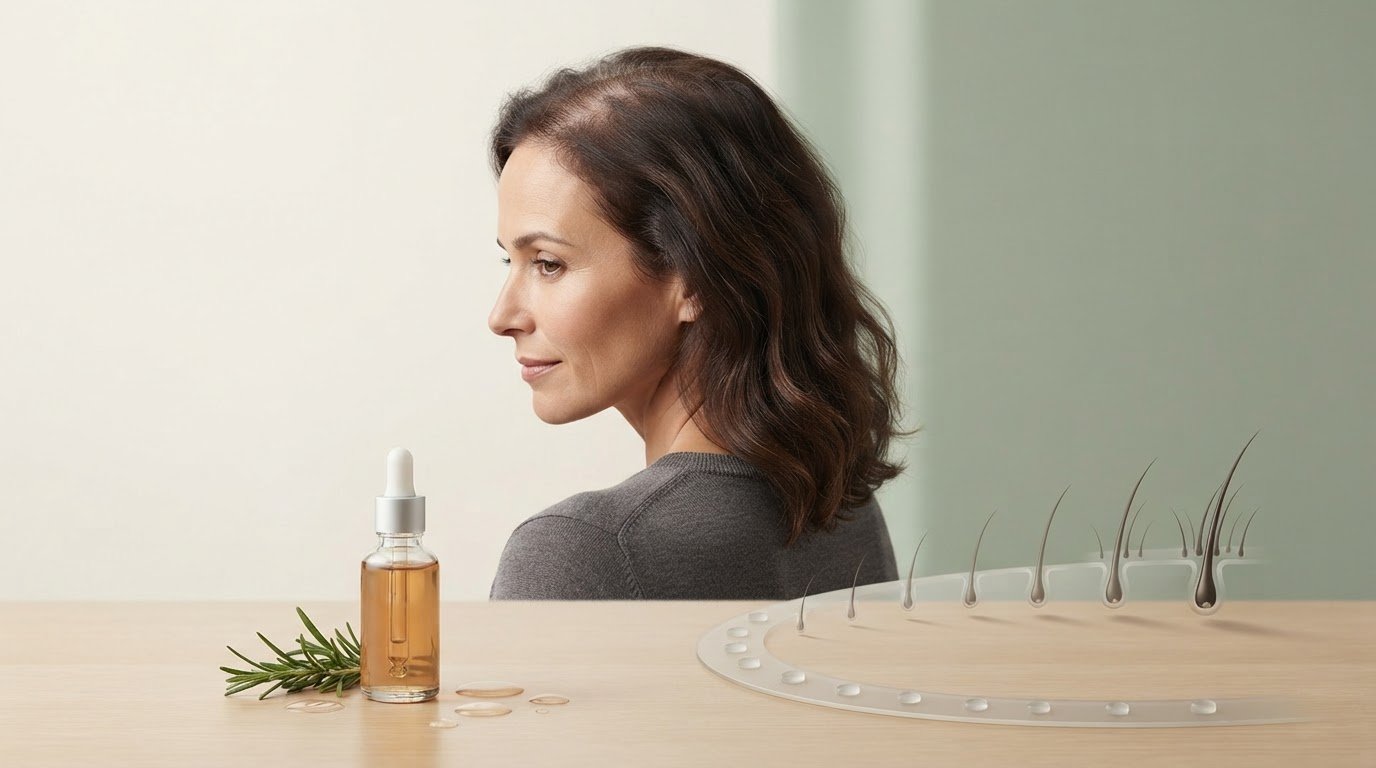
The most compelling serum for thinning hair isn’t automatically the one with the longest ingredient list. There’s no single best option for everyone: minoxidil is one of two FDA-approved drugs for hair growth, while rosemary oil has shown hair-growth results similar to 2% minoxidil. The right choice depends on the active ingredients, your preferences and how consistently you can use the product.
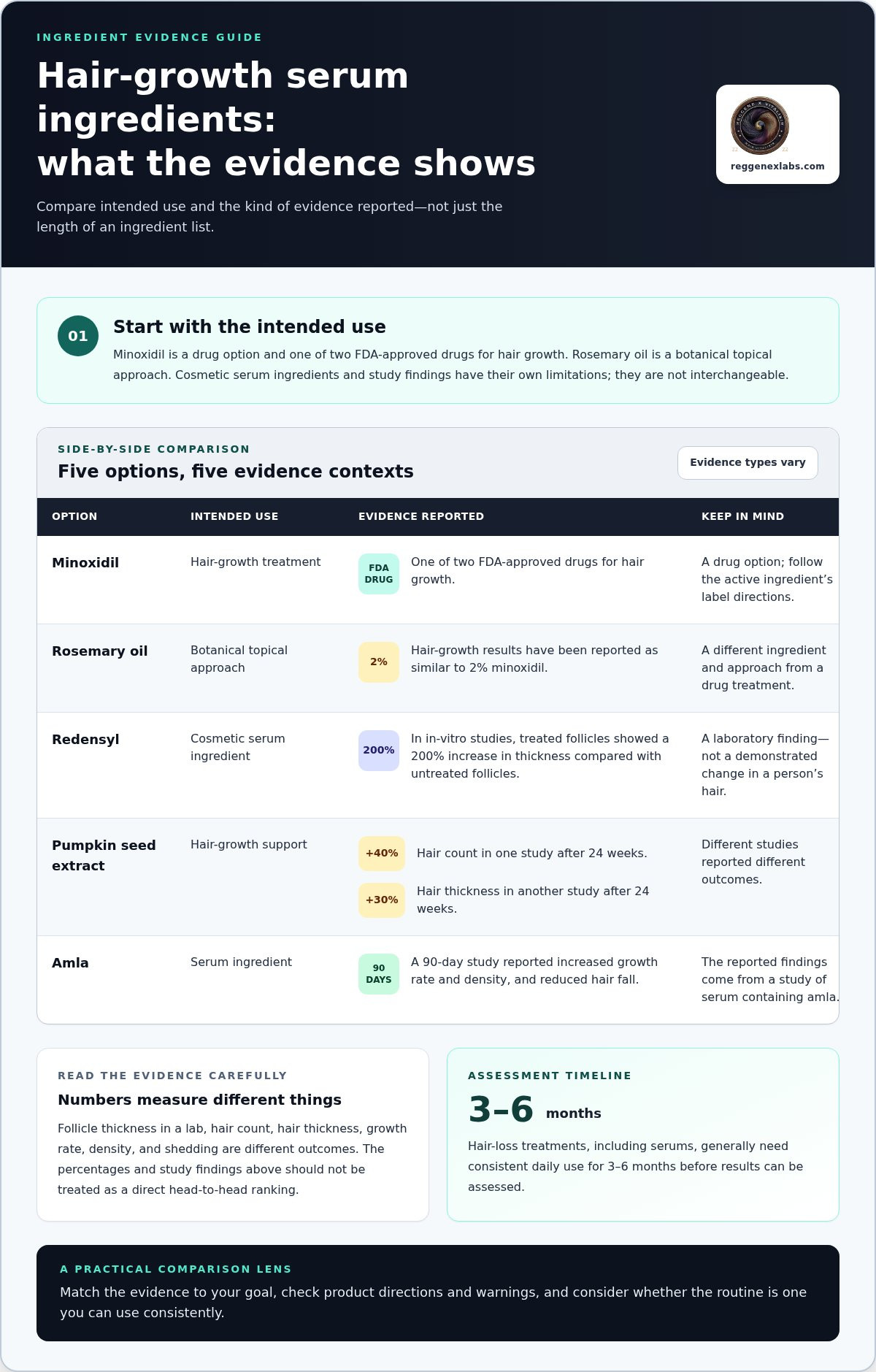
It’s natural to want a clear timeline and visible evidence before committing to a routine. Hair-loss treatments, including serums, generally need consistent daily use for 3-6 months before results can be assessed. This guide compares common serum ingredients, explains what to look for when evaluating products, and outlines realistic treatment timelines so you can choose an approach that fits your needs.
Key Takeaways
- Compare active ingredients by the evidence behind them and the type of support they’re intended to provide.
- Choose fragrance, vegan, and texture preferences that make a consistent routine easier to maintain.
- Set realistic expectations: assess progress over months, not days, and track changes in shedding and coverage.
- Use clear testing criteria to compare application, scalp comfort, and how well a product fits your routine.
What serum is best for hair growth?
Minoxidil is one of two FDA-approved drugs for hair growth; rosemary oil and cosmetic serums have different evidence and intended uses. Before choosing a serum for thinning hair, compare its active ingredients, evidence, and directions with your goal.
Expected Results and Limitations
A hair-growth serum may support visible change, but results vary by ingredient and use. Topical treatments may reduce shedding and slightly improve scalp coverage at three months. Pumpkin seed extract studies report different outcomes: one found a 40% increase in hair count after 24 weeks, while another reported a 30% improvement in hair thickness after 24 weeks.
Redensyl-treated follicles showed a 200% increase in thickness compared with untreated follicles in in-vitro studies. That laboratory result is not the same as a demonstrated change in a person’s hair. A 90-day study of serum containing amla reported increased growth rate and density, and reduced hair fall.
Serums by Intended Use
Choose by purpose, not by ingredient-list length. Minoxidil is a drug option; rosemary oil is a botanical alternative with reported hair-growth results similar to 2% minoxidil. A cosmetic scalp serum may focus on scalp care, while a treatment is selected specifically to address hair loss.
Those categories aren’t interchangeable. In-vitro findings for Redensyl describe follicle responses in a lab, while the amla finding comes from a 90-day study. For someone looking for healthier-looking hair, distinguish cosmetic conditioning from evidence tied to hair count, density, or shedding.
Popular Hair-Growth Serums
Minoxidil, rosemary oil, Redensyl, pumpkin seed extract, and amla are among the options readers may encounter. Their evidence differs: minoxidil is one of two FDA-approved drugs for hair growth; rosemary oil has results reported as similar to 2% minoxidil; and Redensyl findings cited here come from in-vitro work.
Nutrafol is a brand name you may encounter while comparing hair-growth approaches, but it is not an active ingredient or proof of a serum’s performance. Compare the product’s format and formula with your goal, such as reducing shedding or supporting scalp coverage.
Scalp Serums and Hair-Growth Treatments
A scalp serum is applied to the skin, while hair-growth treatments may be medicated or cosmetic. This distinction matters when comparing intended use and evidence. A topical formula acts on the scalp; a product that conditions strands may improve their appearance without addressing the same outcome.
Risks depend on the active ingredient and formulation, so follow the directions and read the warnings before use. During pregnancy or breastfeeding, discuss a medicated serum’s active ingredient with a clinician before starting it.
| Option | Intended use | Evidence noted | Key distinction |
|---|---|---|---|
| Minoxidil | Hair-growth treatment | One of two FDA-approved drugs for hair growth | Drug option |
| Rosemary oil | Botanical topical approach | Results reported similar to 2% minoxidil | Different ingredient |
| Redensyl | Cosmetic serum ingredient | 200% follicle-thickness increase in in-vitro studies | Lab finding |
| Pumpkin seed extract | Hair-growth support | 40% increase in hair count after 24 weeks in one study | Study outcome |
| Amla | Serum ingredient | 90-day study reported growth-rate and density increases | Study duration |
Choose an option whose evidence aligns with your goal, then compare its formula and directions before building a routine.
Fragrance-free, vegan, and other product preferences
Preferences matter because a formula is useful only if you can apply it consistently. Compare fragrance, ingredient origin, texture, hair type, and package directions. A fragrance-free label addresses added fragrance; a vegan preference requires attention to ingredient sourcing, not just botanical imagery.
Use product filters as practical screens, not proof of hair-growth performance. If you avoid fragrance, look for fragrance-free formulas; if you follow a vegan routine, review ingredient lists for animal-derived materials. A keratin claim identifies an ingredient, not a guarantee of stronger hair or increased density.
- Fragrance: Choose fragrance-free products if added scent doesn’t suit your routine.
- Vegan: Review the full ingredient list and any clear vegan labeling.
- Texture: A lightweight liquid may feel different from a richer serum on fine or textured hair.
- Hair concern: Separate scalp-focused products from formulas intended to condition the hair shaft.
Ease of use can determine whether a product fits daily life. Check whether directions call for daily application, whether the formula needs to dry before styling, and whether it fits alongside shampoo and conditioner. Hair-loss treatments, including serums, require consistent daily use over 3-6 months for results to be assessed.
Start with the concern you want to address. Genetic thinning, stress-related shedding, and breakage are different issues: breakage affects strands, while thinning concerns density or coverage. For genetic thinning, compare treatment-focused formulas; for breakage, prioritize hair-shaft care and gentler styling. For stress-related changes, note when shedding began and whether it continues.
In the United States, minoxidil is one of two FDA-approved drugs for hair growth. That does not make every serum FDA-approved. Distinguish a product containing a drug from a cosmetic formula, and follow the active ingredient’s label directions.
A dermatologist can assess your scalp and thinning pattern and help distinguish hair loss from breakage. Arrange an evaluation if thinning is sudden, patchy, or persistent, or comes with scalp changes. These details can help guide the assessment.
Compare products by package size, directions, and cost per application, not bottle price alone. Check for a complete ingredient list and clear use instructions. Don’t choose solely by a “growth” label; match the formula to your concern and routine.
If a scalp-focused routine suits your preferences, explore a hair regrowth serum as one option to compare against your ingredient and application criteria.
More than 13 million Americans use hair loss products in a single year. That level of use makes it especially important to treat product choice as a personal fit rather than a popularity contest. Before buying, confirm that the formula addresses your concern, that its directions are manageable, and that its ingredient information is clear. Keep expectations tied to what the product is intended to do, and avoid assuming that popularity or appealing packaging establishes effectiveness. If a formula causes irritation or does not suit your routine, pause and seek qualified advice rather than layering on additional products. A considered choice is easier to evaluate and maintain.
Hair serum ingredients, including minoxidil, niacinamide, biotin, peptides, and caffeine
Compare active ingredients by type and evidence, not by the number of claims on the label. Minoxidil is a drug ingredient; niacinamide, biotin, peptides, and caffeine appear in drug-free formulas.
Minoxidil-Based Serums
Minoxidil differs from cosmetic ingredients because it is an FDA-approved drug for hair growth. A cited study compared a topical caffeine-based liquid at 0.2% with a minoxidil solution at 5%. Those are different concentrations and ingredients, so the comparison doesn’t make them interchangeable. Check the active ingredient and directions rather than relying on a serum’s general “growth” label.
Drug-Free Serum Ingredients
Drug-free formulas may combine niacinamide, biotin, peptides, caffeine, or botanical ingredients. Their presence alone does not establish that a product will increase hair growth. Compare each formula’s claims with the evidence described, and distinguish findings about an individual ingredient from results for a finished serum.
For caffeine, reported findings include a 37% extension of the hair-growth phase and a 46% increase in hair-shaft elongation. A cited comparison used a 0.2% caffeine liquid and a 5% minoxidil solution. These figures describe reported findings, not a direct guarantee for every caffeine serum. Saw palmetto has been associated with a 50% reduction in scalp androgen receptor activity.
- Niacinamide: Check its position in the ingredient list and the product’s stated purpose.
- Biotin: Distinguish topical biotin in a serum from biotin in a vitamin or supplement.
- Peptides: Compare the specific peptide named and the formula’s evidence, rather than treating all peptides alike.
- Caffeine: Note whether the product identifies its concentration and whether claims concern a finished formula or an ingredient study.
A dermatologist can help interpret ingredient claims in light of your hair-loss pattern and scalp condition. Bring the product label and active-ingredient details to make the discussion specific.
Before choosing, identify the active ingredient, note its concentration if provided, and read the directions. Then decide whether you want a drug-based treatment or a drug-free formula. A vitamin or botanical may suit your preferences, but it is not equivalent to minoxidil. The type of evidence matters as much as the ingredient name.
For a clear comparison, record each product’s ingredients, claims, and evidence type. Keep clinical findings, laboratory findings, and cosmetic positioning separate. This helps you assess what a formula is designed to do and what the cited evidence actually measures.
The women's 5% minoxidil formula was FDA-approved at that strength in 2020, providing a specific regulatory point to consider when comparing active ingredients.
Consistency and treatment timelines
Hair-growth routines need sustained use before their effects can be assessed. Hair-loss treatments, including serums, require consistent daily use over 3-6 months for results to be assessed. A changing routine makes it harder to distinguish a product’s effect from normal shedding or styling changes.
Follow the product directions and keep your routine steady. Record when you start, your application days, and any changes in shedding or scalp coverage. Take progress photos in similar lighting and with the same parting. Consistent records make comparisons clearer than relying on memory or checking the mirror each day.
At three months, people using topical hair-loss treatments may begin to notice reduced shedding and slightly improved scalp coverage. This is an early checkpoint, not a final verdict. Compare your notes and photos with your starting point, and consider whether you have used the product consistently as directed.
After six months of topical treatment, early signs of regrowth may become visible to the naked eye. Hair grows about a quarter to a half inch per month, so changes in length appear gradually. New growth may take time to stand out against existing strands, especially when you’re tracking fuller coverage rather than length.
The most substantial cosmetic improvement from hair-loss treatment is typically seen at 12 months, with stabilization thereafter if treatment continues. This longer view matters: a few weeks of use won’t capture the full timeline. Compare monthly photos and notes, rather than changing formulas after every short-term fluctuation.
- At the start: Record your baseline with photos and a note about shedding or coverage.
- During daily use: Follow the product directions and track missed applications.
- At three months: Review early changes in shedding and scalp coverage.
- At six months: Look for visible regrowth and compare photos under matching conditions.
- At 12 months: Assess the broader cosmetic result and whether continued use maintains it.
Consistency also means distinguishing strengthening from regrowth. A product that improves the feel or appearance of existing strands may not produce the same changes as a treatment aimed at scalp coverage. Track the outcome you care about, such as less shedding, greater visible density, or stronger-feeling hair.
Build a routine you can repeat: choose a time linked to an existing habit, such as after washing, and follow the label’s application instructions. Avoid adding several new products at once, since that makes it difficult to identify which change corresponds with your results. Use the 3-6-month assessment window to evaluate a consistent routine.
Hair serum testing methods and selection criteria
A useful comparison starts with a defined routine, consistent observations, and clear criteria. Testing a serum’s texture can show whether it feels comfortable, but it cannot establish regrowth or increased density. Separate everyday usability from evidence about thicker hair, and note what each test measures.
Testing periods vary. One process used each product for 2-4 weeks before moving it to the next consideration round, with testing continuing for one calendar year. Health tested hair-growth serums for over four months and consulted seven medical and hair-health experts. These examples show why reviewers may assess immediate application separately from longer-term outcomes.
Choose a serum by comparing its formula, directions, usability, and supporting evidence. A consistent routine makes those criteria easier to assess. Keep one product as the main change, follow its label, and record observations regularly instead of switching formulas in response to daily fluctuations.
- Formula: Record the active ingredients and distinguish drug ingredients from cosmetic ones.
- Application: Note the amount, frequency, drying time, and whether the serum fits your existing routine.
- Scalp comfort: Track how your scalp feels after use, including any irritation or residue.
- Outcome: Choose a measurable focus, such as shedding, visible coverage, or strand appearance.
- Evidence: Separate laboratory findings, clinical evaluations, and personal-use feedback.
Application technique can affect how consistently a product reaches the scalp. Hair-serum testers massaged products into their hair for 2-3 minutes during application. Use the product’s own directions first; massage should not replace instructions about where or how much to apply.
Testing a full system differs from evaluating a single serum. A clinical trial included 43 women ages 30-65 using the full system. That design evaluates a combination, so its results don’t isolate the serum’s contribution. When comparing individual products, look for evidence tied to that specific formula and outcome.
For personal tracking, take baseline photos in the same lighting, angle, and parting. Repeat those conditions at each review, then compare the images with notes about application and scalp comfort. This makes changes in visible density easier to assess than relying on memory and helps distinguish a thicker-looking style from increased coverage.
Use this framework to compare a hair regrowth serum option against your routine, ingredient priorities, and evidence criteria.
ReggeneX Labs: ReggeneX Vitalixir Hair Regrowth Serum
ReggeneX Vitalixir Hair Regrowth Serum is one option to consider as you build a consistent scalp-care routine. If you’re comparing formulas and want guidance tailored to your hair and scalp needs, the ReggeneX Vitalixir Hair & Scalp Consultation is a practical next step. Use the ingredient and application criteria in this guide to decide whether a serum for thinning hair suits your preferences and routine.
For a broader care routine, ReggeneX Vitalixir Shampoo and ReggeneX Vitalixir Conditioner are also available. Choose products that align with your goals and follow each product’s directions as part of your regular care.
For more information, visit reggenexlabs.com.
Turn your comparison into a clear next step
Make your next choice a deliberate starting point, not a guess. Before adopting a serum for thinning hair, define what you want to observe and how you’ll track it. Notes on your routine, scalp comfort, and visible changes can help you make a more informed decision over time.
Your response may differ from another person’s, so use your own observations to guide adjustments. If you’d like help deciding how to proceed, ReggeneX Labs offers a Hair & Scalp Consultation to discuss your hair-care needs. A focused conversation can help turn your priorities into a practical routine.
Contact ReggeneX Labs to discuss your next step. Choose with care, stay consistent, and give your routine room to work.
Frequently Asked Questions
What ingredients in hair serums have evidence for treating thinning hair?
Minoxidil has the clearest drug-based evidence among the topical options discussed here. Rosemary oil, caffeine, pumpkin seed extract, and amla have also been studied, but evidence varies by ingredient and study design. For example, laboratory findings about follicles do not establish the same outcome as a study measuring results in people. Compare the specific ingredient, formula, and measured result instead of relying on broad growth claims.
What is the difference between hair-growth serum and scalp serum?
A hair-growth serum is intended to support growth-related outcomes, while a scalp serum may focus on care such as hydration or comfort. The categories can overlap, so check the label for intended use and active ingredients. Applying a product to the scalp does not automatically make it a hair-growth treatment. Match its stated purpose to your concern, whether that is scalp condition or visible thinning.
How much do popular hair-thinning serums cost in the US?
Serum costs vary by formula, package size, and application frequency. Compare the cost per labeled use and how long the package is intended to last, rather than bottle prices alone. A single topical product and a multi-step system are different purchases. Review the full routine and repeat-purchase terms to estimate the ongoing cost of the option you’re considering.
How should you apply hair serum for thinning hair, and how often?
Follow the product label for the amount and frequency, since directions differ by formula. For a scalp-applied serum, part the hair so the product reaches the intended area instead of coating the strands. Apply it evenly, then massage gently for 1-3 minutes if the directions allow. Daily use is common in treatment routines, but the label should guide your schedule and application method.